
The late 1990s produced billions of circulating coins. Most were made for daily use, not for holding and investing in. The 1999 dime is not an exception. The coin is common, modern, and widely available.
Yet collectors are still interested in a theme: can a 1999 dime become an investment piece? Or is it just a face-value issue?
To answer that, we need to look at supply, condition, errors, and market demand.
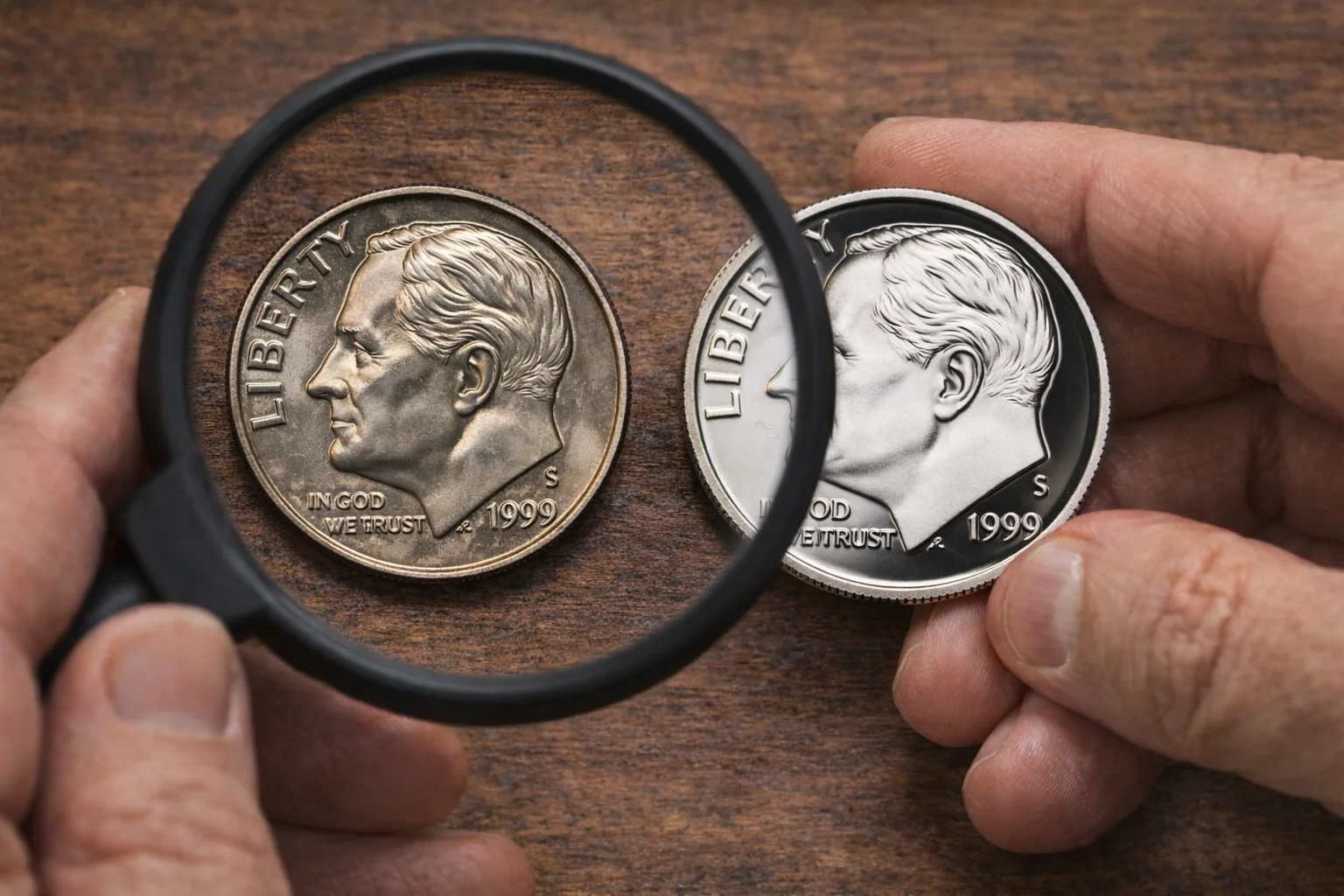
Types of 1999 Dimes
Before discussing potential, we must separate the versions of the 1999 issue:
Business Strike: 1999-P and 1999-D
These coins were struck for everyday circulation and released through normal banking channels. They represent the majority of surviving 1999 dimes.
Parameter | 1999-P | 1999-D |
Purpose | Circulation | Circulation |
Composition | Copper core, nickel outer layer | Copper core, nickel outer layer |
Weight | 2.27 grams | 2.27 grams |
Diameter | 17.91 mm | 17.91 mm |
Edge | Reeded | Reeded |
Surface | Standard strike finish | Standard strike finish |
Both versions were produced in large numbers and entered daily use. Most 1999 dimes encountered today belong to this category.
Proof – 1999-S
Proof dimes were struck for collectors. They feature:
Mirror-like fields
Frosted devices
Higher strike pressure
Careful handling at the Mint
These coins were sold in proof sets and were never intended for circulation.
Silver Proof – 1999-S Silver
This version contains 90% silver. It was issued in special silver proof sets. Unlike business strikes, silver proofs have intrinsic metal value. That metal content provides a price floor, even if collector demand slows.
Each version carries a different market profile. Any investment discussion must treat them separately.
Mintage and Supply
Production levels shape long-term value, too. So, let’s check the table with numbers.
Type | Approximate Mintage |
1999-P | ~1.56 billion |
1999-D | ~1.39 billion |
1999-S Proof | significantly lower |
1999-S Silver Proof | limited compared to clad |
The business strikes were produced in the billions. Supply remains high. Many were stored in mint sets, rolls, and collections.
Proof coins were made in smaller numbers, but they were saved from the start. Survival rate is strong.
Silver proofs have lower mintage than clad proofs, yet they are not scarce in absolute terms.
Large supply limits rapid appreciation. Modern coins require exceptional grade or rarity to stand out.
Condition as the Primary Driver
For business strikes, grade determines everything.
Circulated coins show wear on Roosevelt’s cheek and jawline. Luster fades quickly. Such examples trade at face value.
Mint State coins bring modest premiums. Value increases only as grade rises.
Typical progression:
MS65 – small premium
MS66 – moderate premium
MS67 – significant increase
MS67 Full Bands – strong jump
MS68 – rare and auction-driven
The jump from MS66 to MS67 can be dramatic. Registry collectors compete for top-graded pieces. That competition creates price gaps.
Full Band's status matters even more. The horizontal bands on the torch must show complete separation. Weak strikes lose this designation. Coins with Full Bands attract advanced buyers.
Condition, not year, shapes the price structure for business strikes.
The Role of Full Bands
Full Bands (FB) indicates strong strike quality. The reverse torch design includes two horizontal bands. For the FB designation, both bands must be fully separated.
This detail is difficult to achieve in high grade. Many coins lose clarity due to die wear.
Registry collectors seek FB coins for competitive sets. As a result, MS67 FB examples sell for several times the price of non-FB coins in the same grade.
This factor applies equally to P and D mint coins.
Proof and Silver Proof as Investment Options
Proof coins differ from business strikes in production and market appeal.
Proof dimes show mirror fields and sharp detail. They were sold directly to collectors. Many remain in original packaging.
Prices for clad proofs are usually stable but moderate. They rarely multiply quickly unless condition is exceptional.
Silver proofs carry intrinsic value. The 90% silver content provides a metal-based floor. Even if collector demand weakens, silver content supports the price.
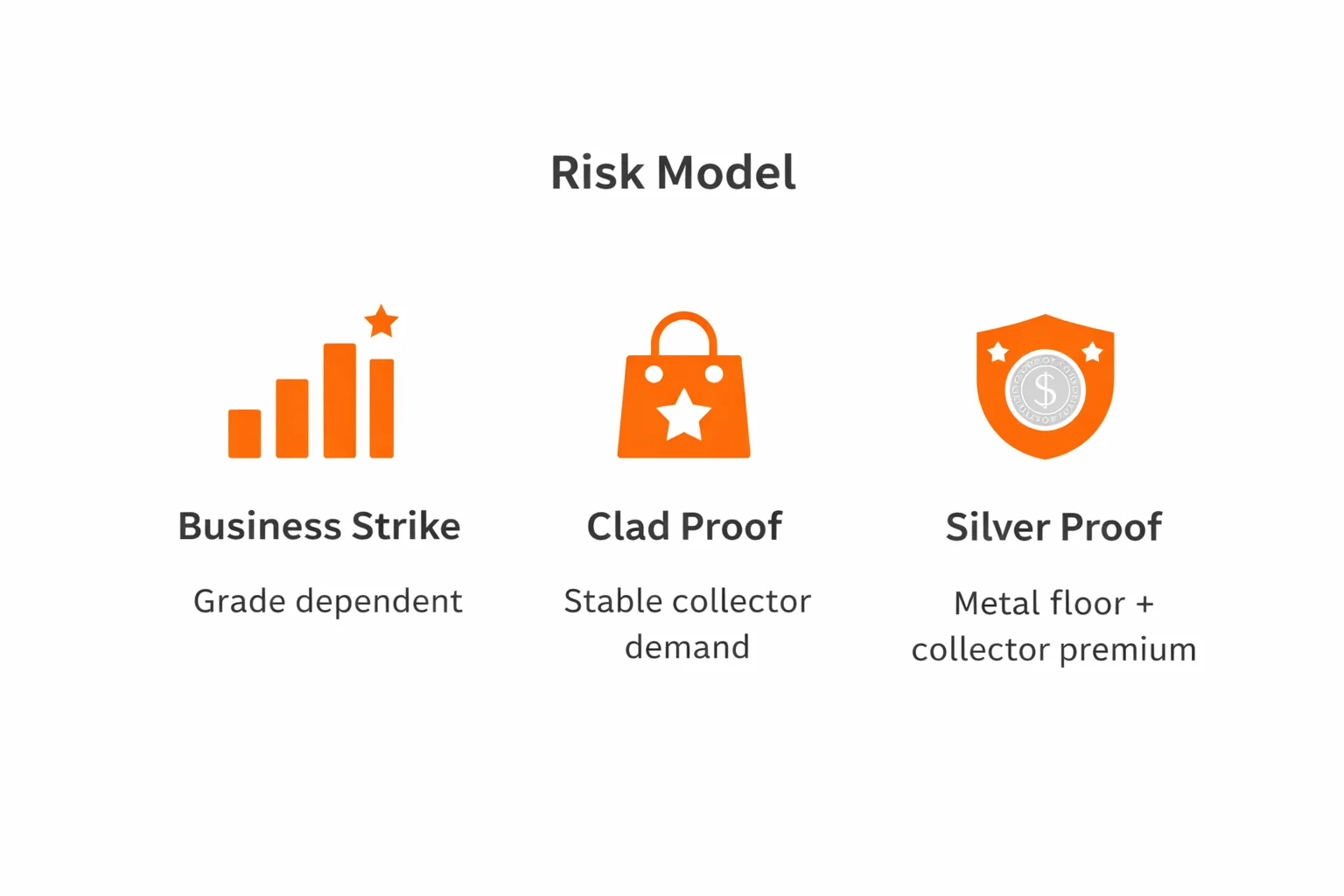
Investment comparison:
Business strike: depends on high grade or error
Clad proof: steady collector demand
Silver proof: metal value plus collector interest
Silver proof versions present a more stable profile because they combine bullion and numismatic appeal.
Error Coins: Confirmed Examples
Error coins introduce a different dimension. They are not common, but they can outperform regular strikes.
Common categories include:
Doubled dies
Off-center strikes
Broadstrikes
Wrong planchet errors
Some detailed examples from 1999 are:
1999-D Doubled Die Obverse (DDO)
This variety shows visible doubling on obverse elements. True hub doubling displays separation and thickness. Machine doubling does not qualify.
Proper attribution increases market value.
1999-P Off-Center Strike
Occurs when the blank shifts during striking. Value depends on the percentage of off-center displacement. Coins with visible dates and a strong shift attract interest.
1999-P Broadstruck on Cent Planchet
A wrong planchet error. The dime was struck on a cent blank. Weight differs from the standard 2.27 grams. Metal color and diameter confirm the anomaly.
These errors can command premiums far above face value. They remain scarce compared to standard issues.
Error coins can be a worthy investment, but they require authentication and verification.
Market Demand and Registry Competition
Roosevelt dimes are not speculative coins. The series has steady demand but limited hype.
Most collectors build date-and-mint sets. Advanced collectors focus on Full Bands examples. Registry platforms increase competition for top grades.
Modern dimes do not experience sudden price spikes unless tied to condition rarity.
Mint sets from 1999 preserved many high-grade coins. That limits scarcity at lower Mint State levels.
True condition rarities - especially MS67 FB and above - remain competitive.
Risks and Limitations
Modern coins carry specific limitations.
Large production numbers reduce rarity.
High survival rates limit scarcity.
Price volatility can occur at top grades.
Certification fees affect net profit.
Modern coins require patience. Appreciation is gradual, not immediate. Overpaying for mid-grade examples reduces long-term return.
Practical Strategy for Collectors
If the goal is investment potential:
Focus on MS67 or higher grades.
Target Full Bands examples.
Verify weight and authenticity for errors.
Avoid cleaned or damaged coins.
Consider certified pieces for resale security.
Quality control is critical. Surface preservation matters more than a year alone.
Before purchasing or grading, collectors can use Coin ID Scanner to confirm the mint mark, composition, and baseline value range. The built-in AI assistant helps clarify identification details quickly. And, nevertheless, final grading decisions should always rely on physical inspection.
Is the 1999 Dime Investment-Grade?
The answer depends on the version and condition:
In circulation form, it is common.
In mid-level Mint State, premiums are limited.
In MS67 Full Bands, the value increases sharply.
In a confirmed error form, it can become highly desirable.
In silver proof format, it benefits from intrinsic metal content.
The 1999 dime is not a key date. It is not scarce by mintage. Its investment profile depends on grade precision and documented varieties.
For most collectors, it fills a standard place in a Roosevelt set. For specialists looking for top-grade or error examples, it can be interesting. So, the outcome is: the coin itself is ordinary, but exceptional examples are worthy.